Understanding Certification Of Analysis For Peptide Sourcing Gabriel Alizaidy, Md, Ms Posted On The Subject
Peptide Screening Hplc & Uplc
- The set identifier on the CoA need to match the vial label specifically.
- It helps buyers move past advertising and marketing cases and take a look at whether the sustaining documents appears structured, certain, and regular.
- Several visitors see a COA and think that merely having one suffices.
- One more logical strategy generally referenced in peptide paperwork is mass spectrometry.
How Peptides Are Examined
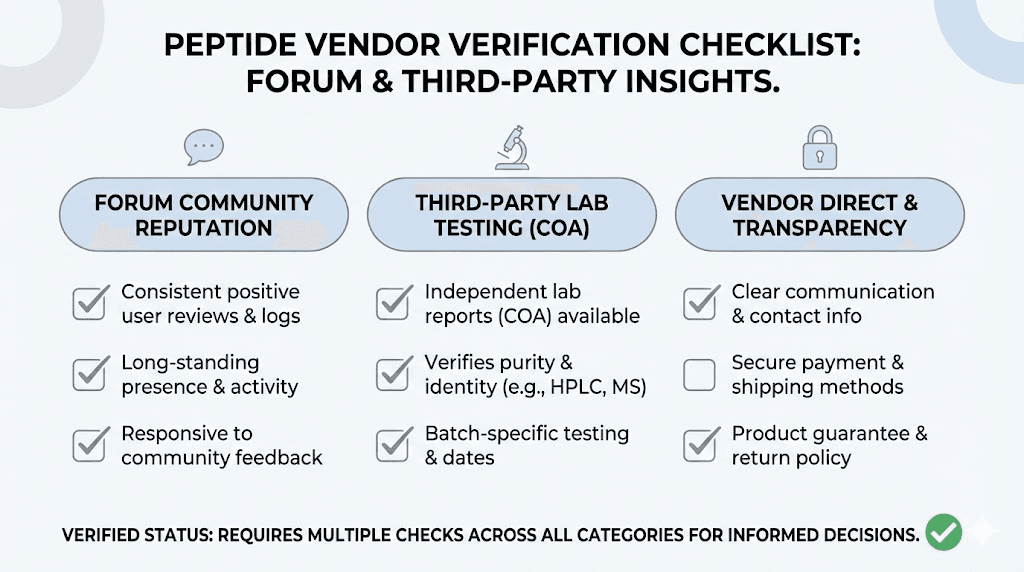
Lots of providers of lab-tested peptides and third-party evaluated peptides release COAs to show transparency regarding their testing processes. These records permit scientists to review analytical proof as opposed to counting solely on descriptive item details. A lot of COAs that flow in the research peptide market are practically certified and virtually useless. Understanding the difference between a COA that passes the list and one that verifies what you are actually holding is the ability this overview covers. For the underlying lab approaches, see our peptide purity testing resource.

The file needs to make it easier, not harder, to link the outcome to a particular set or lot. Nonetheless, despite whether testing is inner or external, the key element continues to be the accessibility of proven peptide certificate of evaluation documents. This info serves for document keeping and lab paperwork. COAs work as an essential resource for compliance and validation in study, permitting researchers to validate that the peptides fulfill called for standards. By comprehending exactly how to read and translate COAs, scientists can make enlightened choices concerning their experiments and the integrity of their outcomes.
Locate Your Coaenter The Batch Number Found On Your Product Label
She holds a BSc in Genetics and a Master's in Public Health (MPH), with a concentrate on mitochondrial scientific research, metabolic health and wellness, and healthy and balanced aging. Chromatograms offer aesthetic confirmation of purity and pollutant distribution, supporting numerical pureness values. Inner quality assurance is necessary, however it does not remove bias. Independent screening gives an additional layer of confirmation.During the examination, a liquid service consisting of the substance passes through a column developed to different molecules based on their chemical properties. Break down of the key sections generally consisted of in a peptide certificate of analysis utilized for research compound verification. Selecting the proper research peptide is essential for the success of any type of clinical study.
What Should I Check Initially On A Peptide Coa?
Each COA is individually examined with Janoshik Analytical and Trustpointe Analytics, verifying batch pureness, fill weight, and substance identification. Each Certificate of Evaluation undertakes a substantial assessment process to Click here for info validate item stability. This record outlines crucial details such as compound identification, batch number, and molecular framework confirmation. In addition, our COAs contain arise from HPLC-MS testing, which verifies the identification of the material with specific analytical methods. Even with a clear procedure in place, it's easy to miss small information, specifically for labs dealing with peptides in chillier weather condition.
However, acknowledge that labs do upgrade their reporting layouts regularly. Confirming COA authenticity calls for methodical cross-referencing and, when possible, independent confirmation. Click to find out more Begin by confirming the screening lab exists and maintains present certification. The fundamental purpose of a COA expands past mere governing conformity. It offers proven proof that the peptide you obtain suits what was gotten, contains the stated purity degree, and is devoid of hazardous pollutants. If the COA consists of very restricted approach information, vague screening recommendations, or vague research laboratory information, it ends up being more challenging to evaluate the logical context behind the outcome.